
Equine Air Travel: What you may not know
Flying horses might sound like something out of a movie, but it’s part of everyday life in today’s global equestrian world. From prep to landing, air travel for horses is a carefully choreographed journey where welfare, logistics and elite performance all take the spotlight.

When you hear that a horse is flying halfway across the world, it is easy to envision a dramatic scene of wings and stakes and stakes of high value. Yet the reality of equine air travel is a finely tuned operation built on logistics. Horses that once moved slowly on roads or by ship now routinely take to the skies, and their journey reveals much about modern horse sport, breeding, commerce and care.
The business of flying horses might seem glamorous, elite show jumpers or stallions bound for breeding seasons, but behind the glamour lies meticulous coordination. A horse bound for competition in Europe may travel from a farm in North America by trailer to an airport with state-of-the-art “air stable” facilities, then load onto a freighter aircraft specially configured for equine transport. Along the way, quarantine, health certification, climate control and specialized grooms all play a role. As one source notes, world-class show jumping or racing horses have become frequent flyers thanks to this evolving infrastructure.
Consider the journey of a high-value show horse. Weeks in advance the export protocols begin: health checks, vaccinations, transport to the airport, acclimation to the stall environment, and paperwork for import/export at the destination. Some of the premier equine cargo hubs feature dedicated stalls and quarantine spaces designed specifically for horses, rather than general livestock. The goal is to ensure that when the horse arrives, it is ready to compete.The costs reflect the value: air transport is not inexpensive, yet for a horse whose performance or breeding potential is measured in hundreds of thousands or even millions, the logistics make sense.
Why has flying horses become such an interesting point of conversation? Chances are you’re reading this because you recognize the global nature of equestrian sport today. Breeding, sales, competition and training all span continents. A stallion in one hemisphere may “shuttle” to the other to cover mares in its off-season; a show jumper may travel from Europe to the Gulf States or from Australia to North America for a major tour. The faster and more smoothly the transport, the lower the stress on the athlete, and the greater the chance of optimal performance.
However, the journey is not without risk or complexity. Welfare concerns associated with long flights, confinement in crates or “jet stalls,” changes in pressure, unfamiliar surroundings and the cumulative effect of transport time are real. Research tracking a group of more than 100 horses on air journeys documented heightened heart rates, respiratory changes, behavioural signs of stress and other markers of impairment during and after flight. Therefore, successful air travel is not simply about booking a flight; it’s about caring for the horse every step of the way.
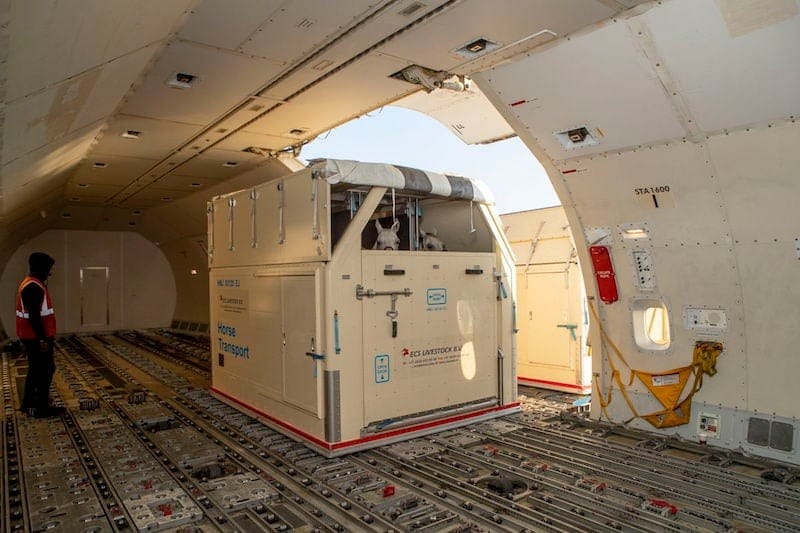
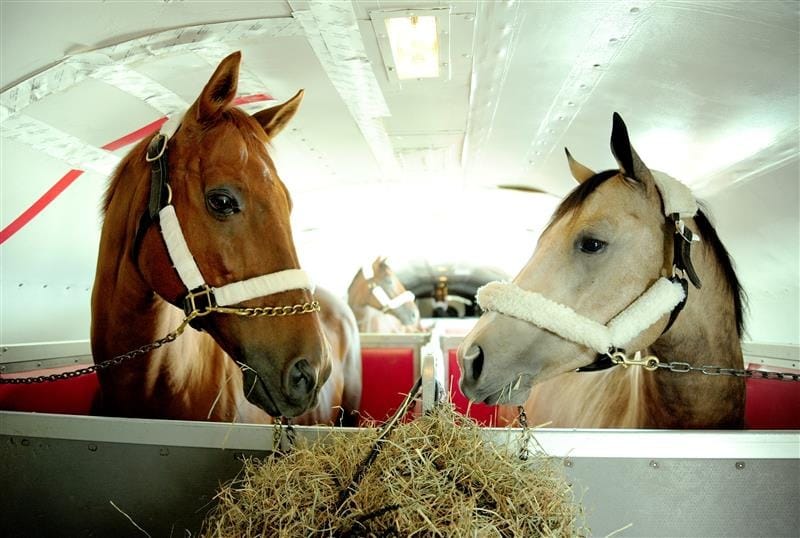
The systems of transport have adapted accordingly. Jet stalls are specially designed containers that fit inside cargo planes. Some hold up to three horses in a compartment, though the configuration may vary according to size, value and the comfort requirements of each animal. As one article explains, air travel for horses now mirrors, in its own way, business class for humans: more room, stable footing, careful monitoring and smoother transitions. On the ground, the horse may travel via specialized trailer to the airport then wait in a calm, climate-controlled area before being led aboard the aircraft.
For many in the equestrian world this evolution is transformative. The ability to ship a high-value athlete across the globe within a short timeframe opens competition and commerce in ways unimaginable just decades ago. Trainers can offer clients far broader programs, breeders can access international markets, and owners can move stallions or mares between hemispheres according to seasonal demand. The economics can work: a transport fee measured in tens of thousands may seem steep, but compared to the stud fee, competition purse or resale value, the investment often pays itself.
But beyond ambition and commerce, there is care. At every step the health of the horse is considered: pre-flight conditioning to reduce risk of respiratory infection or colic, during-flight monitoring of feed and water intake, and post-flight rest and veterinary checks. Some providers and handlers emphasise that a well-prepared horse will handle a flight more smoothly than one subjected to a long road haul filled with stops, unfamiliar smells and jostling terrain.
What can this mean for riders, trainers and horse owners outside the global elite circuit? First, it’s a reminder that the way we travel matters. Attention to footing, calm transport, familiar routines and minimal stress applies even if your horse isn’t flying internationally. Second, the infrastructure built for the elite can trickle down: improved trailers, better health protocols, smarter handling all benefit ordinary barns. Third, for those who do face long-haul travel, say to national championships or international training opportunities, understanding the logistics is critical. Your horse’s success may depend partly on how they arrive, not just where they arrive.
For our equestrian community, these operations are more than logistics. They signal a new era in how we think about horse movement. And the partner side matters: horses that travel well are those that trust their handlers, have been conditioned to the process and have confidence in the team. That trust begins long before the flight.
At TurnoutHQ we believe in the power of preparation, welfare and global connection: whether you are flying a horse across continents or heading to the local arena, the same fundamentals apply. The care you show before departure, your attention during the journey and how you manage arrival will influence performance, health and long-term partnership. By sharing knowledge and standards across barns, trainers and owners, we strengthen the horse community from ground to runway.
So the next time you think of a horse taking to the skies, remember: it is not just a horse in an airplane. It is a high-performance athlete on an important mission. Its comfort, readiness and trust in its team will shape the outcome. And for every one of us, the lessons from that sky-high journey have value at our home barn, our show prep days and our training routines.
Sources
Globetrotting Horses: Welfare Discourses and Disciplinary Power in the Transportation of Horses by Air. Animals (Basel), 2024. (PMC)
Air Horse One: The wonderful world of equine air travel. CNN Travel, 2019. (CNN)
Equine business class. Air Cargo News, 2015. (Air Cargo News)
Flying horses: What to Consider. The Horse, 2015. (The Horse)
Have you seen how horses fly?. The International Equine, 2025. (The international Equine)